This is featured post 1 title
This blog is Bloggerized by wasaeknet - http://wasaeknet.blogspot.com/.
This is featured post 2 title
Replace these every slider sentences with your featured post descriptions.Go to Blogger edit html and find these sentences.Now replace these with your own descriptions.This theme is Bloggerized by Lasantha - Premiumbloggertemplates.com.
This is featured post 3 title
Replace these every slider sentences with your featured post descriptions.Go to Blogger edit html and find these sentences.Now replace these with your own descriptions.This theme is Bloggerized by Lasantha - Premiumbloggertemplates.com.
Showing posts with label The twenties Articles. Show all posts
3/26/10
Invention of the cars
Posted by science vision on 04:05
Invention of the cars
The birth of the car as we know it today occurred over a period of years. It was only in 1885 that the first real car rolled down on to the streets. The earlier attempts, though successful, were steam powered road-vehicles.
The first self-propelled car was built by Nicolas Cugnot in 1769 which could attain speeds of up to 6 km/hour. In 1771 he again designed another steam-driven engine which ran so fast that it rammed into a wall, recording the world’s first accident.
In 1807 Francois Isaac de Rivaz designed the first internal combustion engine. This was subsequently used by him to develop the world’s first vehicle to run on such an engine, one that used a mixture of hydrogen and oxygen to generate energy.
This spawned the birth of a number of designs based on the internal combustion engine in the early nineteenth century with little or no degree of commercial success. In 1860 there after, Jean Joseph Etienne Lenoir built the first successful two-stroke gas driven engine. In 1862 he again built an experimental vehicle driven by his gas-engine, which ran at a speed of 3 kms/hour. These cars became popular and by 1865 could be frequently espied on the roads.
steam-driven engine - silnik parowy
to ram – taranować
internal combustion engine – silnik o spalaniu wewnetrznym
subsequently – później
to spawn – zapoczątkować
two-stroke - dwusuwowy
How did people move when there were no cars?
Human beings have been constructing roadways for over six thousand years.
Travelling on horseback
People were moving on foot,but it wasn’t a good means of transport for long distances.
The best way to move in ancient centuries was travelling on horseback.
Horses were able to carry heavy loads for hours.
In the 19th century, there was no match for the horse for swift travel and communications.
Early roadways carried pedestrians, hoofed animals, and simple wheeled vehicles such as
wagons.
on horseback - na koniu
means of transport – środek transportu
load – ładunek
swift – szybki
pedestrian – pieszy
hoofed animals – zwierzęta kopytne
vehicle – pojazd
wagon – wóz
First wheels
Chariots and wagons.
Chariots were one of the wheeled vehicles that the human invented. Wheels helped transporting people instead of walking everywhere.
This was helpful, expecially in taking royal people to different places. Since wheels roll they are easy to pull and so, the people decided to attach them to vehicles.
Future
The modern automobile, comes from a long list of ancestors.The car of the future will be more economical and safe.Today we can’t imagine life without the basic means of transport.Cars are everywhere and I thing that it will be very difficult to invent a vehicle which could repleace automobile.
Fashion and Clothes Prices 1920's
Posted by science vision on 00:51
Fashion and Clothes Prices 1920's
During the 20's mens fashions became less stuffy and they tried to look more youthful but womens fashions changed much more drastically with women ( flapper style of clothing ) dressing in a way they felt comfortable with not to accentuate the feminine attributes but as a statement of who they were .
Fashion and Clothes Prices From The 1920's
Two of the fashions that are often associated with the 1920s are the cloche hat and the flapper dress. The cloche hat of the 1920s evolved from the wider-brimmed hats of the decade before, and continued to evolve up until the 1930s and beyond.
It is hard to describe the shape of the cloche hat in a few words, because of the fact that so many variations of it exist. However, the basic description of it is that it is a very snug-fit hat that was often worn tilted, covering the forehead, yet allowing room for vision. The hair was often cut short and styled flat to fit under these types of hats.
Cloches were often covered the ears as well, and even sometimes the ends of women’s short haircuts of the time. Often the flapper and the cloche were worn together, especially during the latter half of the 1920s.
The flapper “dress” per se was actually more of a representation of a total style than just the actual dress. However, one distinction of this type of dress was that it was basically a straight and loose style of dress.
Throughout the 1920s decade the length of the flapper dress varied a little. In the early 1920s the length of dresses and skirts were about calf length, with some a little longer and some a bit shorter.
From approximately the years 1926 to 1928 the hem lines of dresses were the shortest, and this is what most people remember when they talk of the 1920s flapper dress. During this short period of time dress hem lines where up to the knees (approximately).
During part of this decade the waist line of dresses dropped to the hip to promote more of a “boyish” look. However, by the early 1930s the waist line of dresses rose back up to its normal waist line position.
Beyond The Cloche And Flapper
The 1920s decade was more than just the cloche and the flapper. In fact, this is the era during which more casual clothing was introduced to the public. For instance, women began to wear pants more often.
Certain styles of women’s shoes designed were unique to this decade as well. One of the most remarkable of this decade’s shoe styles was the ankle strap button shoe. The T-bar shoe was also popular, along with shoe trimmings of sequins or similar materials.
The men of the 1920s era began to abandon formal wear as well. Full suits with long suit jackets were still worn for special events, but more often they began to wear the higher-waisted ones.
Mens Clothing Fashions From The 20s
Men’s suit Lapels where not very wide during the 1920s, which was a trend that was started during World War I (1914 to 1918). This is also the era in which men began to wear cuffed trousers.
Flannel also became increasingly popular, and so did two-toned white and tan or white and black shoes for casual wear. Some of the casual shoes that were worn by men were made with fringed tongues, and/or winged tips.
The black patented leather shoes were still worn for more formal dress. However, the lace-up styled shoe was becoming more and more popular for men.
Additionally, both men and boys often wore short knee pants (knickers) along with sweaters (i.e. Fair Isle slipovers) or casual shirts. Moreover, the shoes that boys wore usually were made of canvas.
One other fashion change that was significant of the 1920s is the fact that baby clothing were designed to be more practical. More comfortable outfits such as rompers and short dresses replaced the frilly laced dresses and other formal baby attire.
For older girls, dress was different as well. They usually were seen wearing items such as cotton frocks, cardigan sweaters, and canvas shoes or sandals.
Mens Clothing Suits (Pre-War) $30.00 New York 1920
Mens Clothing Suits (Post War)$50.00 New York 1920
Silk Lined Suit (Hart Shaffner & Marx) $50 (Sale Price) New York 1920
Boy’s and Girls’ Ribbed Cotton Stockings 35¢ Wisconsin 1921
Girls Bob Evens Middy Blouses $2.75 Wisconsin 1921
Boys Cotton Sweaters 95¢ Wisconsin 1921
Wool Sweaters or Coats $1.98 Wisconsin 1921
Girls’ Serge Dresses (Wood Peter Tom Dresses, Navy, Braid Trimmed) $4.75 Wisconsin 1921
Zepher Yarn Sweaters $5.98 Wisconsin 1921
Children’s All Wool Sweaters $4.98 Wisconsin 1921
Children’s Black Sateen Bloomers 48¢ Wisconsin 1921
Ladies Wool Flannel Robes $3.95 Nebraska 1934
Children’s Union Suits 98¢ Wisconsin 1921
Childrn’s Union Suits 1.25¢ Wisconsin 1921
Boy’s Heavy Fleece Lined Underwear 98¢ Wisconsin 1921
Boys’ Part Wool Ribbed Untion Stuts $1.98 Wisconsin 1921
Children’s Vests and Pants 68¢ Wisconsin 1921
Children’s Black Cat School Stockings (Heavy Ribbed Cotton) 25¢ Wisconsin 1921
Boys Wool Tweed Two-Pants Suits $7.45 to $7.95 Wisconsin 1921
Boys’ Right-Posture Suits $12.98 to $16.50 Wisconsin 1921
Two-Piece Pant Navy Serge Pant Suits $8.95 Wisconsin 1921
Tweed Knickers (for 8 to 18 yrs.) $1.55 Wisconsin 1921
Boys’ Blouses (Various materials and styles) 69 ¢ and 98 ¢ Wisconsin 1921
Boys’ Knickers $1.48, $2.48, and $2.98 Wisconsin 1921
Velvet and Serge Suits (Oliver Twist and Middy Styles) $3.50, $5.00, and $5.95 Wisconsin 1921
Boys’ Shoes Dark Brown, Double-Wear Soled English Walker , Various Sizes From $2.65, Wisconsin 1921
Girls’ Calf Skin Shoes (Various Sizes) From $1.45, Wisconsin 1921
Children’s Pantyhose (Fine Combed Egyptian Yarn) 25¢ Wisconsin 1921
Children’s Hats $2.95 Wisconsin 1921
Children’s All Wool Sweaters $1.98 Wisconsin 1921
Girls’ Pure Worsted Zephyer Sweaters $4.98 Wisconsin 1921
Children’s Black Sateen Bloomers 48¢ Wisconsin 1921
Fall Coats (Ravena, Velour, Polyanna, and other fabrics $29.75 Wisconsin 1921
Women’s Tight Fleeced Union Suits 98¢ Wisconsin 1921
Women’s Sateen Bloomers (Double Sewn) 98¢ Wisconsin 1921
Women’s Wool Skirts $7.50 to $22.50 Wisconsin 1921
Men’s Fall Suits $27.50 to $48.00 Wisconsin 1921
Men’s Dress Shoes (Dark Brown Mahogany Calf Goodyear, Welt Sewed) $4.85 Wisconsin 1921
Cars 1920`s prices
Posted by science vision on 00:47
Cars 1920`s prices
Possibly the most significant change during the 1920's was the mass production of the Car started by Henry Ford, he had manufactured and sold some 15 million Model-Ts by 1927
car prices in the 1920's and how much it cost for a new car
Buick Touring Car (six) Model D $650.00 1921
Cadillac Touring Car $3940 1921
Cadillac Victoria $4540 1921 Wisconsin
Chevrolet Superior Roadster $490.00 1924 Wisconsin
Chevrolet Various Vehicles (Roadsters, Touring Cars, Utility Coups, Sedans)From $490 to $795 1924 Michigan
Dort Six Five Passenger Touring Car $1095 1924 Wisconsin
Ford Runabout $265.00 ($85.00 extra for starter and dismountable rims) 1924 Michigan
Packard Single 6 with 17 miles per gallon with Packard Quality $2975 1920
Willys Overland with 6 Cylinders $985 1925
Money And Inflation 1920`s
Posted by science vision on 00:39
Money And Inflation 1920`s
To provide an estimate we have given a guide to the value of $100 US Dollars for the first year in the decade to the equivalent in todays money
If you have $100 Converted from 1920 to 2009 it would be equivalent to $1023 in todays money
Food Prices From The 1920's -- Homes From The 1920's
how much food and groceries cost in the 20's
Bacon 1 lb. 52¢ 1920
Bacon 1 lb. 47¢ 1925
Beef Rib Roast1 lb 39¢ 1926 New York
Bread 1 lb. 12¢ 1920
Bread 1 lb. 9¢ 1925
Bread 1 lb. 10¢ 1925 New York
Bread 1 lb. 10¢ 1929 Chicago
Butter 1 lb. 70¢ 1920
Butter 1 lb. 55¢ 1925
Butter 1 lb. 56¢ 1929 Chicago
Butter 1 lb. 57¢ 1925 Los Angeles
Cabbage 1 lb. 2¢ 1920 WI
Cheese I lb. 38¢ 1926 New York
Chicken 1 lb. 39¢ 1925 New York
Chicken lb. 42¢ 1929 New York
Codfish 1 lb. 29¢ 1924 WI
Coffee 1 lb. 47¢ 1920
Coffee 1 lb. 52¢ 1925 Washington
Coffee 1 lb. 50¢ 1925
Coffee 1 lb. 45¢ 1929 New York
Cornmeal 1 lb. 7¢ 1925 New York
Cornmeal 1 lb. 6¢ 1929 Los Angeles
Eggs 1 Doz. 47¢ 1920 WI
Eggs 1 doz. 25¢ 1924 WI
Eggs 1 doz. 68¢ 1925
Eggs 1 doz. 55¢ 1925
Eggs 1 doz. 59¢ 1929 New York
Fancy Lake Trout 1 lb. 22¢ 1920 WI
Flour 5 lbs. 41¢ 1920
Flour 5 lbs. 31¢ 1925
Lemons 6 15¢ 1920 WI
Lettuce 3 Heads 25¢ 1924 WI
macaroni 3 lbs 25¢ 1924 WI
Milk ½ Gal. 33¢ 1920
Milk ½ Gal. 28¢ 1925
Navy Beans 1 lb. 10¢ 1926 New York
Norwegian Sardines in Olive Oil 15¢ 1924 WI
Peaches 1 lb. 17¢ 1924 WI
Pineapple Sunbeam 40¢ 1924 WI
Potatoes 10 lbs. 63¢ 1920
Potatoes 10 lbs. 36¢ 1925
Prunes 1 lb. 3¢ 1920 WI
Prunes 3 lbs. 25¢ 1924 WI
Pure Lard 5 lbs. $1.20 1920 WI
Round Steak 1 lb.40¢ 1920
Round Steak 1 lb. 36¢ 1925
Round Beef Steak 1 lb. 36¢ 1926 Chicago
Round Beef Steaks 1 lb. 43¢ 1925 New York
Round Beef Steaks 1 lb. 51¢ 1929 New York
Sugar 5 lbs. 97¢ 1920
Sugar 5 lbs. 35¢ 1925
Watermelon 1 lb. 2¢ 1920 WI
1920s Home style
Posted by science vision on 00:36
1920s Home style
A basic floor plan of a house in the 1920s included two bedrooms right next to one another at one end of the house with a bathroom adjacent to one of the bedrooms. The kitchen and dining room are also proximity to this bathroom, which is fairly small.
The living room of this house is fairly large-about the same size as the kitchen and dining room put together. Off of the living room is an exit with a porch.
Other homes during the 1920s were built with two-stall garages or a sunroof. Additionally, the yard around homes was often landscaped.
Sample Floor Plan of Home in 1928 and 1920s Living Room
Home Sizes and Prices
Home sized varied, and ranged in prices from a few thousand dollars to about ten thousand dollars for a four to six room home. Some homes were designed for one family but quite often they were designed for more than one family to live next to one another.
1920s Home Flooring
Oak hardwood flooring was a hit in the 1920s as well. This is a classic type of woodworking that is often used and admired to this present day. It was most likely used in the kitchen dining room and/or living room, but could have also been used in other rooms of the house as well.
Linoleum Floor Patterns were also very popular during the early twenties (1924). Linoleum is the same floor material that is used in many kitchens today.
Home Exteriors in the 1920s
A little bit more of an unusual exterior for a 1920s home is one that was designed with green shingled roofing all the way to the bottom of the windows. From that point up, wood siding was installed.
Other Roofing Materials of 1920s Homes
One style of roofing used in the 1920s was vulcanite hexagon slabs. These shingles were made from asphalt. Other types of weatherproof shingling were also made to be placed over the top of old wood roofing. Additionally, common colors for shingling in these days were green, red, or blue-black.
Picture of Vulcanite Hexagon Slabs:
Furnishings Placed in 1920s Homes
Furniture and décor that was placed in 1920s home had a look all of its own for the decade. You may notice furniture in people’s homes today of a similar style made from the same materials. If so, it is a possibility that these furniture pieces you see in people’s homes today may be 1920s’ originals.
Bedrooms:
A large number of bedroom dresser and vanity furniture pieces were made of sturdy materials such as oak, walnut, cedar, or mahogany woods. Dressers and vanities both were usually made of an elegant yet simple carved wood design (as appearing in ad photos).
The styles of beds used during the 1920s varied. For example, in 1923 simple metal beds with two-inch posts that came with mattresses and springs were placed in rooms. In 1928 double beds were made out of similar carved wood frames along with corresponding bedroom dresser or vanity pieces.
Another metal bed is signature of the 1920s decade-the Simmons bed in graceline tubing. This bed was designed with a w/decorated steel center and high grade link fabric springs. The Liberty mattress made sleeping more comfortable for those who were to use this bed.
A similar model of Simmons bed that is very similar to the one described in the previous paragraph is designed with a walnut finish. This bed contains five filler rods in each end, as well as the same high grade link fabric springs and all cotton Liberty mattress.
Living Room:
In the early 1920s, living room furniture sets often included a number of coordinating pieces, such as an arm chair, reception chair, arm rocker, tabourette, bookend, and table. Another very popular item that was displayed during the early 1920s (and perhaps later) is the very distinct wrought iron bridge lamp.
Picture of Wrought Iron Bridge Lamp:
Drapery Materials
Cretonne, Silk, or Pongee Materials were often used to make draperies, especially for the living room or family room. It is most likely that curtains were made for the kitchen and bathroom from similar materials which more than likely of a lighter grade.
Living Room Sets
A living room set that is fairly typical of this particular time in history is a three piece living room set made from mohair fabric. This particular set would usually include pieces of furniture such as an 84-inch davenport, club chair, and wing chair with reversible spring cushions (made in 1928).
Three-piece living rooms such as the one described above were very common. However, one of the best deals for furniture that is offered during the 1920s is the 14-piece furniture set. This suite would usually consist of two chairs and couch, which are all upholstered.
Additional items were included with this set such as a Floor lamp with pleated shade, small round lamp table (appears in photo to be of a glass top), magazine basket, and bronze book ends were also included. .
Other types of lamps besides the bridge lamp described earlier in this section include various junior, floor, and table models of lamps. These particular units usually were made with polyester, chrome, or mahogany bases and glass or silk lampshades with fringed trim.
One other popular item that was used to decorate homes in this era was a rug made of materials such as worsted wool or velvet. Usually these were placed in the center of a living room or dining room floor, and sometimes in the bedroom.
Kitchen:
Kitchen furniture was often installed in homes during the 1920s, especially if homes were not already designed with built-in shelves and cupboards. One of the most common additions made to a home during this decade was a piece such as the 36-inch high kitchen cabinet. This cabinet was most likely made of oak or other strong wood.
Another oak kitchen cabinet that was installed in a home of this time period was a kitchen cabinet with a white porcelain top. This is one of the items that helped make kitchen cooking duties easier.
Appliances and Electronic Equipment
Since the invention of electricity towards the end of the 19th century, new household items have been invented. Numerous appliances were made to help ease the burden of house chores.
For instance, there was a unit called the Universal chafing dish, flat iron, and washing machine. This had appeared in a 1924 ad in Green Bay , Wisconsin .
Another item that was often used was the electric clothes washer made by Western Electric. This photo will help you get an idea of what one of these items looked like.
Vacuum cleaners have been invented by this time, and have become more modernized. The following is a photo of an ad for a Hoover vacuum cleaner that was displayed in a 1920 newspaper:
The Kitchen Ice Box
Another common unit used during this time was the ice box, however it is noted that this unit was most likely not electrical at this time. This unit was the early version of a modern-day refrigerator. It acts as a huge cooler, which is filled with ice.
The interior of this icebox was lined with galvanized steel, and appears to be encased in a finished wood exterior (see photo below). This was a unit that was very popular in homes during the late 1920s.
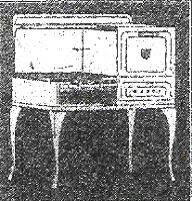
Cooking appliances that were considered state-of-the art during this time include the 16-inch oven and broiler. This particular unit has one giant and three standard burners and is build with concealed construction.
Imagine cooking on this unit pictured below, which cost only $59 on sale in the year 1928 (WI, USA ):
Another unit was installed in homes from time to time as well.
Gas-Coal Combination Unit:
Some Pictures of some of the items to be found in 1920's Kitchen
Dining Room:
The dining room was one of the most lived-in rooms of the entire house. Therefore, the furniture in these rooms was usually quite simple but elegant-just like most of the other furniture built in the 1920s. Dining room furniture sets often included an average of eight pieces.
One eight piece dining set that was created during this decade was one that included a 60-inch buffet, oblong extension table with a cut-cornered edges, five dinner chairs and host chair. The picture that appeared along with the description of this ad very strongly leads one to believe that the seats of the chair were covered with either velour or tapestry upholstery.
Another eight-piece dining set of the 1920s was made out of walnut. This set included a buffet, host chair, five dinner chairs, and table with six legs and decorative stretchers (on table legs).
Other signature pieces of this era include the Queen Ann Table which was displayed in an ad in the year 1924, and the 9x12 velvet rug. The rug could possibly have been used to accent either a dining room floor or a living room floor.
Baby’s Room:
Quite a bit of baby’s furniture in the 1920s was made from enameled metal or enameled wicker (a type of straw). For instance, families with a baby during this time period often owned a white enameled wicker baby’s wardrobe w/folding drawers (1923). This may have been set up in a baby’s room along with a white enameled metal crib with drop sides (possibly 28x52 inch unit).
1920s-The Birth of Radio Broadcasting and Household Radios
Studies of the history of radio conclude that radio broadcasting first took place at the beginning of the decade (in the year 1920). Then, from the years of 1923 to 1930 more than half of American households had already owned their own radios.
In later years the crystal that was used to make the original household radios was replaced by a vacuum tube. This greatly improved the reception of the original radio. This radio improvement was first by a man named Edwin Armstrong. The first model of radio that was designed with this vacuum tube was the Radiola Superheterodyne.
Another line of radios was created in later years. For example, in the year 1925 the combination phonographic radio was created. The following is an example of what an Orthophonic Victrola radio looked like in the year 1925 (edited drawing taken from a WI newspaper):
The above model of phonograph/radio was usually one that sat in most living rooms or dining rooms. Over the years of course much smaller hand-held and portable radios were developed as well (i.e. the 1928 R.C.A. Radiola 18).
1928_icebox
1928_range
fringed_lamps
gas_coal_combo
graceline_bed
hexagon_slabs
hoover_vacuum
universal_wash_chafing_and_iron
worst_wool_rug